
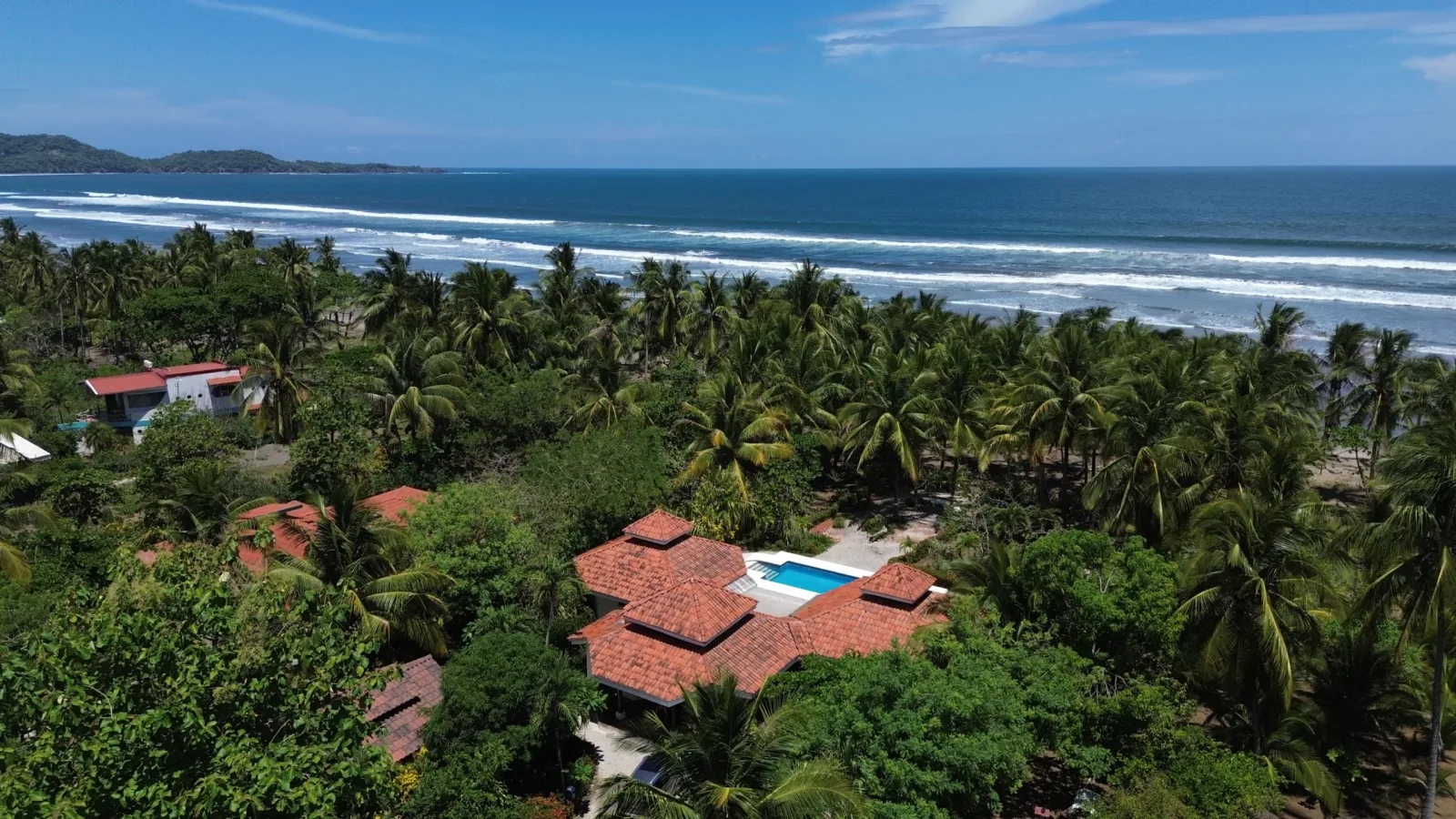
The land closest to the water is leased, not sold. What a concession is, the 5-to-20-year term the law actually sets, who may legally hold one, and what to check first.
Almost every conversation about beachfront property in Costa Rica runs into the same surprise: the land closest to the water is not usually sold at all. It is leased, by the municipality, for a fixed number of years — and the rules about who may hold that lease are stricter than most international buyers expect.
None of which makes beachfront a bad buy. It makes it a different instrument, with its own term, its own annual cost and its own renewal risk. This guide sets out what a concession actually is, who can legally hold one, and what to check before any money moves.
The 200 metres that change everything. Measured inland from the ordinary high-tide line, the first 200 metres are the Maritime Terrestrial Zone (Zona Marítimo Terrestre, ZMT). The first 50 metres are public domain — nobody may build on them or fence them off, ever. The next 150 metres are the restricted zone, which can only be occupied under a concession granted by the local municipality.
What a concession actually is
A concession is a lease of public land, granted by the municipality and recorded in a dedicated section of the National Registry. The state remains the owner; you hold the right to occupy and develop the plot according to the approved zoning, and you pay the municipality an annual fee — the canon — set by regulation according to the use and the valuation of the plot.
The term is where published guidance most often goes wrong. Article 48 of the Maritime Zone Law (Ley 6043) sets concessions at no less than five and no more than twenty years. You will see twenty to forty years quoted in various places, including on our own older page. It is not what the statute says, and the difference matters a great deal when you are valuing an asset.
Concessions are extended by successive renewals rather than running indefinitely, and each extension is itself subject to the same maximum. Renewal is applied for, not automatic: the municipality notifies the holder of the approaching expiry, and the request has to go in within three months of that notice. A holder who is current on the canon, compliant with the zoning and in good standing has every reason to expect renewal — but "expects" is the honest word, not "guaranteed".
Titled property and concession property, side by side
| Titled (propiedad privada) | Concession (concesión) | |
|---|---|---|
| What you hold | Freehold ownership, registered in your name or your company's, with no expiry date | A lease from the municipality for a fixed term, renewable on application |
| Where it is | Anywhere outside the 200-metre zone — plus a small number of parcels inside it titled before the 1977 law | Only within the restricted 150-metre strip |
| Foreign buyers | The same rights as a Costa Rican citizen | Restricted — see below |
| Annual cost | Property tax at 0.25% of the registered value | A municipal canon, set by use and valuation rather than a flat rate |
| Financing | Normal mortgage territory, including the U.S. and Canadian programmes | Much harder — most lenders will not take a concession as security |
Who can legally hold one
This is the part to get right before falling in love with a plot. Article 47 of Ley 6043 says a concession may not be granted to:
- A foreign natural person who has not resided in Costa Rica for at least five years.
- A company whose shares are bearer shares.
- A company domiciled abroad.
- An entity set up in Costa Rica by foreigners.
- Any entity in which more than 50% of the capital belongs to foreigners.
In practice that means a foreign buyer without five years of residency holds a concession through a Costa Rican company in which Costa Rican nationals genuinely hold at least 51%.
Be careful here, and be sceptical of anyone who waves it away. The same article prohibits transferring shares to foreigners in contravention of the rule, and transfers made in breach of it are without legal effect. Structures built to give a foreign buyer effective control while a nominal local shareholder holds the majority on paper are therefore exposed in a way that a simple titled purchase never is. If someone presents that as a routine formality, get a second opinion from a lawyer you appointed yourself.
Check there is a zoning plan at all
A gate that catches people out before any of the above becomes relevant: under Article 38, a municipality cannot grant concessions in an area that has no approved regulatory plan (plan regulador). Stretches of the Costa Rican coast still have none, or have one that is out of date or under revision.
No plan means no new concession, and sometimes means a freeze on transfers of existing ones. Establish the status of the plan for that specific beach before paying for anything else — it is a question your attorney can answer at the municipality and with the Costa Rican Tourism Institute (ICT), which is involved in approving these plans.
Checking a specific concession
Once the area clears, the concession itself needs the same scrutiny a title would get, plus a few things that only apply here:
- Is it registered and active? The concession should appear in the National Registry's concession section, with its term and current holder.
- How many years are left? Not the original term — the remaining one. This is the single biggest driver of what the asset is worth.
- Is the canon paid up? Arrears sit with the concession, and a history of non-payment is a problem at renewal.
- What does the zoning actually permit? The plan regulador governs use, density and setbacks. What is built is not always what is permitted.
- Is the current holder eligible? If the existing structure breaches the foreign-ownership rule, you are inheriting that problem.
- Does any of it sit in the first 50 metres? Construction in the public zone cannot be regularised by buying it.
The process, step by step
1. Due diligence at the municipality and the ICT
Your attorney pulls the file at both. The checks are the ones above: active status, remaining term, permitted use, canon payments, and whether the plan regulador supports what you intend to do with the plot.
2. Agreement and corporate structure
The purchase agreement is signed and, if a company is required, it is formed to comply with the shareholding rule. Funds move through a regulated escrow account rather than directly to the seller — our guide to escrow in Costa Rica covers how to check a provider is properly registered.
3. Municipal transfer and registration
The deed is executed before a notary and a formal request goes to the municipality to transfer the concession. The transfer requires approval — by the municipal council, and by the ICT where applicable — before it is recorded in the National Registry. Build that approval time into the contract's deadlines; it is not a same-week formality.
So is a concession worth it?
For the right buyer, yes. Concession plots put you where titled land simply does not exist, the supply cannot grow, and the annual canon is often lower than the property tax on an equivalent titled parcel. Plenty of Costa Rica's best-loved coastal homes sit on them.
But go in with the instrument you are actually buying clear in your mind: a renewable lease with a finite term, a compliance obligation, restricted ownership, and limited financing options. If those terms do not suit you, the answer is not to engineer around them — it is to buy titled land a little further back, which on much of this coast still has the view. We cover that trade-off for one stretch of the Central Pacific in our guide to buying in Tivives.
Tell us which beach you have in mind and we will tell you honestly whether what you are looking at is titled or concession, how long is left on it, and what it would take to hold it legally. You can also browse by area or search what is available.
This guide summarises the Maritime Terrestrial Zone Law (Ley 6043) and its regulations as they stand at the time of writing; statutes, regulatory plans and municipal practice all change. It is general information, not legal advice. Before committing to a concession purchase, take advice from a Costa Rican attorney you have appointed yourself and who is independent of the seller.